
Your New House Is Not Ready Yet. Where Does Your Stuff Go?
Here is a situation more common than people realise.
You have to vacate your current house by the end of the month. The new one is not ready the painting is still going on, or the owner needs two more weeks, or the registry paperwork is stuck. You have a fully furnished home and nowhere to put it.
Or maybe you are renovating. You cannot move back in until the floors are done, but you also cannot live around wet cement and power tools with a full household of furniture and appliances.
Or you got a job transfer on short notice. You are moving to another city for six months, maybe a year, and it does not make sense to take everything – but you do not want to sell it either.
In all of these situations, the answer is the same: temporary storage. And yet it is one of the least understood services in the moving industry.
We get calls about this regularly atMohali Express. People are surprised to find out that a moving company handles storage too that you do not have to figure out two separate vendors, two separate vehicles, two separate headaches. This post explains how storage works, when it makes sense, and what to actually look for before you hand over your belongings.
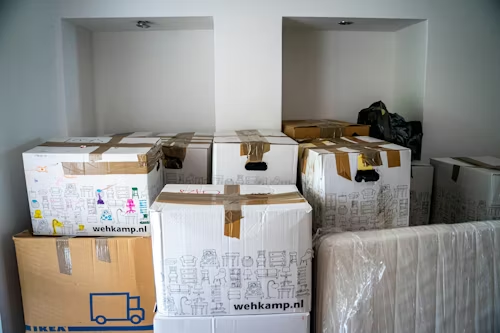
What Storage During a Move Actually Means
When most people hear ‘storage facility‘ they picture a dusty government godown or a relative’s garage with boxes piled to the ceiling. That is not what we are talking about.
A proper moving storage facility is a secure warehouse where your packed belongings are kept under controlled conditions protected from moisture, pests, theft, and physical damage for however long you need. It could be two weeks. It could be six months.
The way it typically works: your belongings are packed and loaded exactly as they would be for a normal move. Instead of going straight to the new address, they go into storage. When you are ready when the new house is available, the renovation is done, or you have decided what to do next they come out and get delivered.
The best part is that when you use a moving company that offers both services, you avoid double-handling. Your things are packed once, stored, and delivered. No repacking, no second truck booking, no coordination stress.
When Does Temporary Storage Actually Make Sense?
It is not always obvious when storage is the right call. Here are the situations we see most often.
Gap Between Moving Out and Moving In
This is the most common one. Your lease ends on the 30th. Possession of the new place is on the 15th of next month. You have a 15-day gap with nowhere to go.
Some people try to manage this by staying at a relative’s place and cramming furniture into whatever corners are available. It is uncomfortable, it puts strain on relationships, and it often results in damage to belongings that were never properly packed for a temporary shift.
Storage solves this cleanly. Move out on the 30th, let us take everything to the warehouse, pick it all up and deliver to the new address on the 15th. You stay wherever makes sense for those two weeks without your entire household in tow.
Home Renovation or Interiors Work
Renovation is underestimated as a storage trigger. People think they will just move things from room to room as the work progresses. In practice, a house mid-renovation is chaotic — cement dust gets everywhere, things get moved by workers and put back in the wrong places, and valuable furniture sits exposed to construction activity for weeks.
Clearing the house into storage before work begins means the renovation goes faster, the workers have space to actually work, and your belongings come back clean and undamaged once everything is done.
Downsizing
You are moving from a 3BHK to a 2BHK. There is furniture and equipment you are not sure what to do with yet. You do not want to sell it in a hurry, but you cannot fit it in the new place.
Storage buys you time to decide. Put the excess in the warehouse for a month or two, settle into the new place, figure out what you actually have room for, then decide what to sell, give away, or bring in.
Job Transfer or Temporary Relocation
A posting to another city for six months to a year. You do not want to ship everything, but you also do not want to sell furniture you will need when you return.
Store the big items the sofa, the bed frames, the dining table take only what you need for the temporary stay, and pick everything up when you are back. Much cheaper than replacing everything later.
NRIs or Families Returning to India
Families returning from abroad sometimes need a few weeks between landing and getting settled into a permanent address. Storage lets them arrive, take their time finding the right place, and have their belongings delivered once they are ready.
What to Check Before You Trust a Storage Facility
Not all storage is the same. There are facilities in the Tricity area that are little more than locked rooms with no climate control, no pest management, and no real accountability. Your belongings sit in there for a month and come out smelling of damp or worse.
Here is what actually matters.
Physical Security
The basics: the facility should have CCTV covering all storage areas, secure locks, and restricted access. Your belongings should not be accessible to anyone who walks in off the street. Ask who has access to the storage area and what the process is for entry and exit.
Protection From Moisture and Pests
This is the one most people forget to ask about. Mohali and the Tricity area sees significant monsoon humidity. A warehouse without proper moisture control will have items coming out with mould, rust, or water damage after a few weeks.
Ask specifically: is the facility ventilated? Is there pest treatment done regularly? How is humidity managed? A good facility will answer these questions without hesitation.
Inventory Documentation
Before anything goes into storage, a proper inventory should be made. Every item listed, photographed, and signed off by both parties. This is your protection if anything goes missing or comes back damaged.
If a storage provider is not willing to do this, that tells you something.
Insurance Coverage
Ask directly: are your belongings covered while in storage, and for what? Understand what is and is not included. Items of significant value electronics, jewellery, artwork may need separate declaration.
Access During Storage
Sometimes you need to retrieve something from storage before the full delivery. Maybe you realise you need a specific document, or a piece of equipment for work. Ask whether you can access your belongings during the storage period and what the process is.
How to Prepare Your Belongings for Storage
Even if you are handing the packing over to professionals, knowing what goes into proper preparation helps you ask the right questions and understand what is being done with your things.
Everything Needs to Be Clean and Dry
Moisture is the biggest enemy of stored items. Furniture, appliances, and fabric items need to be completely dry before they go into storage. Even a slightly damp item in a sealed environment will develop mould within days.
- Clean all furniture surfaces and let them air dry completely.
- Drain and dry all appliances washing machines, refrigerators, coolers.
- Do not store damp clothing or linens.
Disassemble Where Possible
Large furniture takes up a lot of storage space assembled. Beds, dining tables, and wardrobes should be disassembled where possible. This reduces the space used, which reduces your cost, and also reduces the risk of damage to protruding parts during loading and unloading.
- Keep all screws and fittings in labelled ziplock bags taped to the item they belong to.
- Photograph furniture before disassembly so reassembly is easier later.
Do Not Store These Items
Some items should never go into a storage facility, regardless of how good the facility is.
- Perishable food of any kind.
- LPG cylinders or any pressurised containers.
- Flammable liquids — paint, petrol, cleaning solvents.
- Cash, original property documents, passports, or irreplaceable legal documents. Keep these with you.
- Live plants.
Label Everything
Every box and every piece of furniture should be labelled clearly. When your items come out of storage weeks later, clear labels save enormous time during the delivery and unpacking process. Mark fragile items, mark which room each box belongs to, and mark anything that needs special handling.
Short-Term vs Long-Term Storage: What Changes
A two-week storage during a house gap and a six-month storage during a job transfer are very different situations, and they are priced and managed differently.
Short-Term (Under a Month)
For short gaps, the priority is quick in and quick out. Packing does not need to be as thorough because the items are not sitting for long. Cost is usually calculated per day or per week. Access requests are easier to accommodate.
Medium to Long-Term (One Month and Beyond)
For longer storage, packing needs to be more thorough. Furniture should be wrapped in moving blankets or stretch wrap to protect against gradual dust accumulation. Electronics should be kept in their original packaging where possible, or in sealed boxes with silica gel packs to absorb moisture.
For items stored more than three months, it is worth asking the facility whether they do periodic checks on the stored goods. A good warehouse will inspect stored items at regular intervals and flag any issues.
Pricing for longer storage is usually negotiated as a monthly rate. Ask whether there is a discount for booking multiple months upfront.
Questions to Ask Before You Book
When you call a storage provider, these are the questions worth asking directly:
- Is the facility owned by you or do you subcontract to a third-party warehouse?
- What security measures are in place CCTV, access control, night watchman?
- How is the facility protected from monsoon humidity and pests?
- Do you provide a written inventory with photographs before storage begins?
- What insurance is included and what are the exclusions?
- Can I access my belongings during the storage period, and what is the process?
- What is the pricing structure daily, weekly, monthly?
- What happens if I need to extend the storage period?
A provider who answers these questions clearly and confidently is one you can trust. Vague answers or reluctance to commit to documentation are warning signs.
The Mohali Express Approach to Storage
We operate out of Zirakpur and serve the entire Tricity Mohali, Chandigarh, Panchkula, and surrounding areas. Storage is one of our own services, not something we hand off to a third party.
When your belongings go into our warehouse, we document everything before it goes in. You get a written inventory. The facility has CCTV, controlled access, and is treated for pests. Items stored for longer periods are checked periodically.
Because we handle both moving and storage, you do not need to coordinate two separate vendors or book two trucks. We pack, we store, and when you are ready, we deliver. One team, one point of contact, one less thing to manage during what is already a stressful time.
If you are in a situation where you need temporary storage whether for a week or several months call us and tell us about it. We will figure out the right plan.